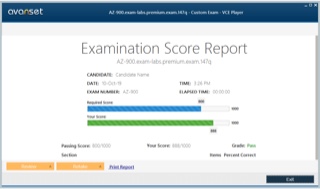
practice exams:
Pass Arcitura Education Certification Exams at the First Attempt Easily
Real Arcitura Education Exam Questions, Accurate & Verified Answers As Experienced in the Actual Test!
Exam |
Title |
Files |
|---|---|---|
Arcitura Education Certification Exam Dumps, Arcitura Education Practice Test Questions
Don't miss out on the opportunity to get certified with the help of this ever-popular ExamLabs platform that provides you with only verified and legit Arcitura Education certification practice test questions and answers in VCE format, training courses, and study guides. So, if you're looking to pass your Arcitura Education certification exams then with ExamLabs practice test questions and exam dumps you can surely pass your exam quickly and easily.
Arcitura Certifications: Cloud, AI, Big Data, and Architecture
Arcitura Education takes a vendor-neutral approach to technology certification. Instead of organizing every credential around one cloud provider, software platform, or product line, its programs teach reusable concepts, patterns, mechanisms, architecture, and professional practices. Arcitura's current catalog spans cloud computing, artificial intelligence, big data, machine learning, service technology, digital security, DevOps, IoT, and related architecture disciplines.
That approach changes how candidates should study. A vendor-neutral certification asks whether you understand why an architectural pattern works and when it should be used, not merely whether you remember one provider's service name. The certification path has strong concept-level credentials including several Arcitura subject areas, including cloud computing fundamentals and big-data concepts.
Arcitura organizes learning into modular professional tracks
Arcitura describes a catalog of professional certification programs built from course modules and associated exams. Current offerings include certifications such as Cloud Technology Professional, Cloud Architect, Cloud Security Specialist, AI Professional, Big Data Professional, Big Data Engineer, Big Data Architect, Machine Learning Specialist, and additional role-focused credentials.
The modular model is useful for professionals who need breadth before specialization. A learner can establish common cloud or data concepts, then move toward architecture, security, engineering, or analytics. Candidates should still consult the current Arcitura track map because prerequisite combinations, module groupings, and exam details can vary by certification.
Cloud Technology Professional establishes provider-neutral foundations
Cloud fundamentals begin with resource pooling, elasticity, measured usage, virtualization, remote access, shared responsibility, availability, and service/delivery models. These ideas are portable across providers even though AWS, Azure, Google Cloud, Alibaba Cloud, and private-cloud platforms implement them differently.
A review of cloud architecture can help candidates connect those terms to system design. For example, elasticity is not simply “the cloud scales.” Architects need to know what triggers scaling, which components are stateful, what capacity cannot scale instantly, how costs change, and how the application behaves while capacity is being added or removed.
Arcitura's own public pages currently show some variation in administrative details such as stated exam duration across different catalog surfaces. Candidates should therefore confirm the live exam page immediately before scheduling rather than hard-coding a time limit from an older PDF or cached catalog.
Cloud architecture is about patterns and tradeoffs
A vendor-neutral cloud architect should be able to reason about load distribution, stateless and stateful components, redundancy, failover, geographic distribution, data replication, messaging, caching, identity, observability, automation, and recovery. The design should satisfy explicit requirements instead of chasing the maximum possible score on every quality attribute.
High availability, for example, can increase cost and complexity. Strong consistency can reduce some forms of flexibility. Multi-region resilience can introduce replication lag and operational overhead. Good architecture makes those tradeoffs visible and documents why the chosen balance fits the business.
Architecture documentation should describe forces, not just components. A diagram that shows a load balancer, compute nodes, and a database is incomplete unless it explains traffic assumptions, state, scaling triggers, failure behavior, security boundaries, and recovery. Vendor-neutral study is valuable because it encourages candidates to describe those forces before choosing a product implementation.
Patterns also have preconditions. Caching improves latency only when stale data is acceptable within a defined window and invalidation is controlled. Asynchronous messaging improves decoupling but introduces eventual consistency and duplicate-delivery concerns. Circuit breakers prevent cascading failure but need sensible thresholds and recovery behavior.
Big data study should follow the data lifecycle
Big-data systems deal with scale, variety, velocity, distributed processing, storage, ingestion, transformation, governance, and analytics. The concept is easier to retain when studied as a lifecycle: data originates in systems or devices, enters a platform, is stored and processed, becomes accessible to analytics or models, is governed, and is eventually archived or deleted.
A useful starting point is a big-data learning path that introduces the skills and roles around the field. Candidates should then distinguish batch from streaming, structured from unstructured data, operational stores from analytical stores, and raw ingestion from curated data products.
The article comparing data science, big data, and data analytics is useful because the terms are often blurred. Big-data engineering provides scalable data systems; analytics turns data into descriptive or diagnostic insight; data science may add statistical modeling and prediction. Real projects can combine all three.
Cloud and big data increasingly converge
Large-scale data platforms are often built on elastic cloud infrastructure because compute, object storage, managed databases, streaming services, and analytics engines can be provisioned without owning all underlying hardware. The relationship is explored in the focused explanation on big data and cloud computing.
Vendor-neutral candidates should learn the architectural pattern first. Separate storage from compute when that improves elasticity, partition data intentionally, design for retries, make processing idempotent, monitor data quality, and understand the cost of moving and retaining large datasets. Provider-specific service names can then be mapped onto the pattern later.
AI Professional study should separate models from systems
Arcitura's current AI Professional path covers generative and predictive AI concepts and their application in business contexts. Candidates should understand data, training and inference at a conceptual level, model limitations, evaluation, responsible use, and how AI capabilities are embedded inside larger systems.
A model is only one component. Production AI may require data preparation, identity, retrieval, APIs, monitoring, feedback, human approval, security controls, and cost management. Generative AI adds concerns such as hallucination, prompt injection, context management, grounding, and evaluation. Predictive systems raise related questions about data quality, drift, bias, and whether the prediction supports a meaningful decision.
Responsible AI should be tied to concrete decisions. Ask whose data trained or informs the system, what groups could be harmed by errors, whether users know when they are interacting with AI, what appeal or human-review path exists, and how the organization monitors unexpected behavior. Abstract principles become useful only when they change design or operating decisions.
Evaluation also differs by task. Classification may have measurable precision and recall, while generative work may require groundedness, correctness, usefulness, safety, or human preference judgments. Candidates should be comfortable defining success before selecting an evaluation technique.
Machine learning in the cloud adds operational concerns
The relationship between machine learning and cloud computing is useful for understanding why AI credentials increasingly overlap with platform architecture. Training may need burst compute, inference may need low latency, data pipelines must be repeatable, and models need versioning and monitoring.
Vendor-neutral preparation should cover the lifecycle: define the problem, collect and prepare data, train and evaluate, deploy, observe, detect drift, retrain or retire, and govern access. A model with strong offline accuracy can still fail operationally if its inputs change or the system cannot meet latency and availability requirements.
Security should be designed across every technology layer.
Cloud security depends on identity and access control, network boundaries, encryption, key management, logging, vulnerability management, secure development, incident response, and governance. Vendor-neutral certification is a good place to learn why these controls exist before learning a provider's implementation.
Security design starts by identifying assets, actors, trust boundaries, and threats. A data lake, for example, may contain more sensitive information than the applications that feed it. An AI system may expose confidential context through logs or retrieved documents even when the model itself is securely hosted. Controls should follow the flow of information through the entire architecture.
Vendor neutrality is useful only if candidates can map concepts to reality.
The risk of vendor-neutral study is staying too abstract. Candidates should deliberately map each concept to at least two concrete technologies. If studying object storage, compare how two cloud platforms implement it. If studying queues, deploy two implementations. If studying identity federation, draw how the abstract trust relationship appears in a real enterprise.
This cross-mapping exposes what is fundamental and what is vendor-specific. It also helps architects avoid designing a system around a product feature they do not truly understand. Concept-first learning becomes more practical, not less, when it is tested against real implementations.
Multi-cloud thinking should not become an assumption that every workload must run identically everywhere. Portability has costs. The right question is which layers genuinely benefit from standardization and which can use provider-specific capabilities because the business value exceeds switching risk. Architecture should make that choice explicit.
Similarly, open standards can reduce lock-in without eliminating it. Data formats, APIs, containers, identity protocols, and infrastructure-as-code practices can improve portability, but operating procedures, managed-service semantics, skills, and commercial commitments still create dependencies. Vendor-neutral professionals should understand these economic and organizational forms of lock-in as well as technical ones.
Build a concept-to-implementation study matrix
- Start with the current Arcitura certification track and identify required modules and exams.
- Create one column for the vendor-neutral concept and separate columns for real implementations.
- For architecture patterns, record the problem solved, forces, benefits, tradeoffs, and failure modes.
- For data and AI, follow the lifecycle from source through operation and governance.
- Build small labs on more than one platform where practical.
- Keep administrative details such as exam duration and delivery tied to the live Arcitura page because public catalog surfaces can differ.
- Use practice questions to test concepts, then explain the answer without relying on a vendor product name.
Arcitura is strongest as a transferable architecture foundation.
Arcitura's value proposition is portability. Cloud platforms change, data products are renamed, AI tooling evolves quickly, and organizations often use multiple vendors simultaneously. A professional who understands distributed systems, architecture patterns, data lifecycles, AI systems, security, and operational tradeoffs can transfer that knowledge more easily than someone who only memorizes one product catalog.
Use concept articles to deepen topics already present in the Arcitura curriculum, not to manufacture links to unrelated vendors. The goal is a coherent vendor-neutral foundation that can later be mapped onto AWS, Azure, Google Cloud, private platforms, data ecosystems, or AI stacks as the job requires.
Updated & latest Arcitura Education certification exam dumps from ExamLabs, Study Guide and Training Courses which are prepared by seasoned experts in order to help you pass. With Real Arcitura Education certification practice test questions and answers and verified exam dumps you will pass the Actual Real World Exam in No Time. Arcitura Education exam dumps & practice test questions with answers from ExamLabs make sure that you pass your Arcitura Education certifications easily and climb you career ladder easily.
How to Open VCE Files
Please keep in mind before downloading file you need to install Avanset Exam Simulator Software to open VCE files. Click here to download software.