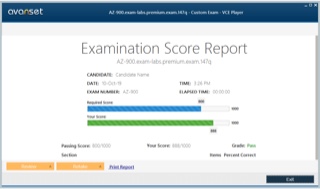
practice exams:
Pass HDI Certification Exams at the First Attempt Easily
Real HDI Exam Questions, Accurate & Verified Answers As Experienced in the Actual Test!
HDI Certification Exam Dumps, HDI Practice Test Questions
Don't miss out on the opportunity to get certified with the help of this ever-popular ExamLabs platform that provides you with only verified and legit HDI certification practice test questions and answers in VCE format, training courses, and study guides. So, if you're looking to pass your HDI certification exams then with ExamLabs practice test questions and exam dumps you can surely pass your exam quickly and easily.
HDI Certifications: Support, Desktop, KCS, and Service Leadership
HDI is a professional training and certification organization focused on service desks, support centers, desktop support, knowledge management, leadership, and service-management practice. Its current portfolio includes HDI Customer Service Representative (HDI-CSR), Support Center Analyst (HDI-SCA), Desktop Advanced Support Technician (HDI-DAST), Support Center Team Lead, Support Center Manager, Desktop Support Manager, Support Center Director, KCS Foundation and Principles, Problem Management Professional, Technical Support Professional, and newer specialist programs such as Artificial Intelligence in the Support Organization.
HDI's current training and certification system should be studied on its own terms, with emphasis on support-center practice, service management, customer experience, troubleshooting, knowledge management, and leadership. Unrelated certifications that happen to share similar abbreviations should not be treated as HDI credentials.
Customer Service Representative builds frontline interaction skills
HDI-CSR is designed for professionals in customer service centers, call centers, and support centers. Current training covers customer needs, communication, conflict resolution, empathy, emotional intelligence, prioritization, technology, and service/support best practices.
Customer service competence is not scripted politeness. Representatives need to listen, confirm the problem, manage expectations, de-escalate difficult interactions, protect confidential information, document accurately, and know when to transfer or escalate.
Practice should use realistic conversations. One customer may be technically correct but angry; another may not know how to describe the problem; another may be experiencing an outage affecting a critical deadline. The representative's communication changes while the support process remains disciplined.
Support Center Analyst combines customer service and incident management
HDI Support Center Analyst is aimed at frontline technical support professionals. Current HDI course material covers incident management, critical thinking, service-management processes, communication, customer interactions, difficult customers, and the role of the support center.
An analyst should capture enough information to make the incident useful: affected user/service, symptom, impact, urgency, environment, recent changes, troubleshooting performed, error text, timestamps, and contact information. Poor tickets create repeated work and weak operational data.
Incident handling should be consistent. Detect/report, record, categorize, prioritize, diagnose, escalate where required, resolve, verify with the user, and close with meaningful documentation.
Prioritization should combine impact and urgency rather than reward the loudest caller. An outage affecting one executive can be urgent, but a silent failure affecting hundreds of users may have greater impact. Support centers need a consistent priority model that analysts can explain.
Escalation should transfer ownership cleanly. Include troubleshooting already performed, evidence, business impact, user availability, and the exact reason the issue needs the next team. A ticket that merely says “escalated to network” forces the next analyst to restart discovery.
Desktop Advanced Support Technician adds deeper technical support
HDI's current desktop path uses Desktop Advanced Support Technician (HDI-DAST). The role goes beyond basic help-desk interaction into troubleshooting, resources, processes, technical support, and more complex user/device issues.
Desktop support today includes Windows/macOS, endpoint management, identity, networks, applications, peripherals, collaboration tools, remote access, security controls, and cloud-connected services. A device problem can originate in local hardware, policy, identity, DNS, VPN, MDM, SaaS, or user profile.
Troubleshooting should begin with scope: one user, one device, one network, one site, one application, or many users? This immediately narrows the likely layer.
Knowledge-Centered Service turns resolution into reusable knowledge
KCS is a major HDI learning area. Knowledge-Centered Service integrates knowledge creation and maintenance into support workflows rather than treating documentation as a separate after-hours activity.
When analysts solve incidents, they search existing knowledge, reuse what applies, improve articles as they learn, and create new knowledge when needed. This reduces repeated diagnosis and helps new analysts become productive faster.
Knowledge quality depends on structure, findability, ownership, review, and user feedback. A huge repository of duplicate or stale articles can slow support more than having fewer well-maintained articles.
Good knowledge articles are written for reuse at the moment of need. Titles should use language users or analysts actually search. Symptoms, environment, cause, resolution, validation, and caveats should be clear enough that another person can apply the article safely.
Article health can be measured through reuse, link/usefulness feedback, resolution contribution, stale content, duplicate rate, and search success. Publication count alone is a weak KCS metric because it can reward volume instead of useful knowledge.
Support leadership adds people, process, and business alignment
HDI Support Center Team Lead, Manager, Director, and Desktop Support Manager certifications move from individual case handling into team performance and service leadership. Leaders need staffing, coaching, quality, metrics, finance, strategy, customer experience, processes, service levels, technology, vendors, and continuous improvement.
A team lead focuses heavily on daily execution and coaching. A manager designs and runs the support operation. A director aligns support with organizational strategy and business value.
Metrics should support decisions: abandonment, response time, resolution time, first contact resolution, reopen rate, backlog, customer satisfaction, knowledge use, quality, employee experience, and cost can each reveal different problems.
Workforce planning should use contact demand, channel mix, handle time, schedule, skills, shrinkage, leave, and service goals. Chronic understaffing can create poor customer outcomes and burnout even when analysts are individually skilled.
Quality programs should sample interactions consistently, calibrate evaluators, coach specific behaviors, and distinguish compliance defects from development opportunities. Scores are useful when they improve service, not when they become a punitive ranking.
Problem management looks for causes beyond individual incidents
Incident management restores service. Problem management looks for underlying causes, recurring patterns, workarounds, and prevention. HDI offers dedicated problem-management training/certification for professionals who need this deeper discipline.
A recurring login failure resolved by resetting passwords may be an incident pattern. Problem analysis might reveal synchronization, identity-provider, policy, or application defects. The goal is reducing recurrence rather than celebrating fast repeated fixes.
Use trend data, major-incident reviews, root-cause techniques, known errors, and change coordination. Root cause should be supported by evidence, not the first plausible explanation.
Major incidents should also produce structured learning. Record timeline, impact, communications, technical cause, contributing process issues, workaround, permanent corrective actions, owners, and deadlines. The review should improve the service rather than become a search for individual blame.
AI is becoming part of the support organization
HDI now offers Artificial Intelligence in the Support Organization, with a certification exam included in the training program. The current course examines how AI affects support work, automation, knowledge, agents, service experience, and organizational practice.
AI can summarize tickets, suggest knowledge, classify requests, assist agents, power self-service, or automate routine actions. It also creates risk: hallucination, data leakage, wrong remediation, user frustration, and over-automation.
Support teams need clear boundaries. AI suggestions should be validated, high-impact actions need authorization, sensitive data should be protected, and teams should measure whether AI actually improves resolution, quality, or customer effort.
Self-service success should be measured by whether users actually solve the problem, not only by chatbot containment. A bot that prevents escalation but leaves the user stuck can make the metric look better while customer effort gets worse.
Agent-assist tools should show source knowledge where possible so analysts can verify recommendations. High-risk actions such as password resets, access changes, remote commands, or account disablement need authorization controls even when AI suggests them.
HDI exams are based on certification standards
HDI training and certification is built around published certification standards and category weightings. Current online exams are delivered through the HDI Community Learning Portal, with exam duration, question count, passing score, and category weights varying by certification.
For example, some specialist exams use 30–35 multiple-choice questions and an 80 percent passing threshold, while support-role exams may use different weighting and length. Retakes and exam extensions are available under current HDI policies.
Do not memorize logistics from another HDI course. Use the specific certification page and Standard for the credential being pursued.
ITIL concepts can complement HDI support practice.
HDI course prerequisites and recommendations frequently reference ITIL 4 for higher support leadership roles. The relationship is logical: HDI focuses deeply on support-center roles and service experience, while ITIL provides a broader service-management framework.
Support analysts do not need to turn every ticket into framework terminology, but they should understand incident, problem, change, service level, knowledge, request, and continual-improvement concepts well enough to work inside a service-management organization.
Higher-level HDI candidates should be able to connect team operations to business value rather than only optimize ticket counts.
Prepare with one support operation, not isolated flashcards
- Select the HDI certification by actual role: CSR, analyst, desktop support, lead, manager, director, KCS, or problem management.
- Use the current HDI Certification Standard and weighting.
- Practice complete incidents from intake through verification and closure.
- Write and improve knowledge during troubleshooting.
- Use metrics to identify one support-process improvement.
- For leaders, practice coaching, staffing, service-level, and business-alignment scenarios.
- For AI, test usefulness and risk rather than assuming automation equals improvement.
HDI certification validates the human and operational side of technology support. Technical skill matters, but reliable service also depends on communication, process, knowledge, leadership, measurement, and a disciplined way to learn from every customer interaction. Service-desk scenarios become more realistic when they combine technical triage with ownership, escalation, SLA awareness, knowledge capture, and clear communication to the person waiting for restoration.
Practice.
Updated & latest HDI certification exam dumps from ExamLabs, Study Guide and Training Courses which are prepared by seasoned experts in order to help you pass. With Real HDI certification practice test questions and answers and verified exam dumps you will pass the Actual Real World Exam in No Time. HDI exam dumps & practice test questions with answers from ExamLabs make sure that you pass your HDI certifications easily and climb you career ladder easily.
How to Open VCE Files
Please keep in mind before downloading file you need to install Avanset Exam Simulator Software to open VCE files. Click here to download software.