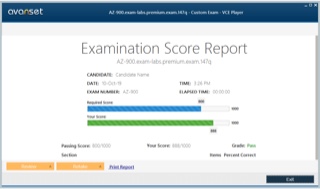
practice exams:
Pass CyberArk Certification Exams at the First Attempt Easily
Real CyberArk Exam Questions, Accurate & Verified Answers As Experienced in the Actual Test!
Exam |
Title |
Files |
|---|---|---|
|
1
|
||
|
6
|
||
|
3
|
||
|
3
|
||
|
1
|
||
|
1
|
||
|
1
|
||
|
1
|
||
|
1
|
||
|
1
|
||
|
1
|
CyberArk Certification Exam Dumps, CyberArk Practice Test Questions
Don't miss out on the opportunity to get certified with the help of this ever-popular ExamLabs platform that provides you with only verified and legit CyberArk certification practice test questions and answers in VCE format, training courses, and study guides. So, if you're looking to pass your CyberArk certification exams then with ExamLabs practice test questions and exam dumps you can surely pass your exam quickly and easily.
CyberArk Certifications: Defender, Sentry, PAM, and Privilege Cloud
CyberArk's current certification structure is organized around three major technical levels: Defender, Sentry, and Guardian. Defender credentials validate day-to-day operation and support of a CyberArk solution. Sentry validates deployment, installation, and configuration. Guardian validates advanced knowledge across CyberArk solutions and the ability to combine architecture with privileged-account security strategy.
Relevant credentials and exams include PAM Defender, PAM Sentry, Secrets Manager Sentry, and CyberArk Guardian. Pearson VUE's current CyberArk page confirms the Defender/Sentry/Guardian structure and current exam-family names.
Defender is the operational certification level
CyberArk Defender certifications focus on maintaining daily solution operation and ongoing performance. Current Defender exams include PAM, Endpoint Privilege Manager, and Access. The role is administration and support rather than greenfield architecture.
For PAM Defender, candidates should understand safes, accounts, platforms, password rotation, reconciliation, session access, monitoring, users/groups, access control, onboarding, reporting, health, and ordinary troubleshooting.
Operations should be repeatable. Administrators need onboarding standards, naming, ownership, safe membership, platform assignment, exception handling, credential rotation windows, monitoring, and offboarding. A PAM program can become unmanageable if every account is onboarded differently.
PAM is about controlling privileged identity lifecycle
Privileged accounts include administrator identities, service accounts, application accounts, emergency accounts, database credentials, network-device credentials, cloud privileges, and other identities capable of high-impact actions. PAM reduces risk by controlling credential storage, rotation, access, session use, and accountability.
The objective is not simply hiding passwords in a vault. Strong PAM removes standing knowledge where possible, rotates secrets, grants access through controlled workflows, monitors high-risk sessions, and ensures administrators have only the privilege needed for the task.
Inventory comes first. Organizations cannot protect privileged identities they do not know exist. Discovery, ownership, classification, onboarding, usage monitoring, rotation, and eventual decommissioning form a lifecycle.
Service accounts are often the hardest identities to manage because applications can depend on them continuously. Before rotating a service credential, administrators need to know every dependent system, configuration file, scheduled task, service, or integration that consumes it. Discovery and dependency mapping reduce the risk that a security improvement causes an outage.
Emergency or break-glass accounts should be rare, protected, monitored, and tested. An emergency path that no one has verified may fail during the exact incident it was meant to support, while an overused break-glass account can become a permanent bypass of PAM controls.
Sentry validates deployment and configuration skill
CyberArk Sentry credentials focus on installing and configuring solutions. The current Pearson VUE catalog includes PAM Sentry, Privilege Cloud Sentry, and Secrets Manager Sentry. These professionals need enough architecture knowledge to create a secure, supportable deployment.
The PAM Sentry exam should be prepared by building components, integrating identity, configuring safes and platforms, enabling password management, testing session management, establishing backups, and validating network and certificate requirements.
Deployment decisions should include availability and recovery. A privileged-access platform is a critical dependency during incidents, so architecture needs redundancy, protected backup, break-glass procedures, and monitoring.
Network design should minimize unnecessary exposure among vault, session, connector, directory, target, and management components. Required ports and trust relationships should be documented explicitly. Broad firewall rules can make an installation easier while weakening the security boundary around the privileged-access platform.
Certificates should have owners and renewal procedures. PAM platforms often depend on TLS, directory trust, and secure web access; an expired certificate can look like an authentication or component failure if the team has not tracked the lifecycle.
Privilege Cloud changes infrastructure ownership, not security responsibility
CyberArk Privilege Cloud moves parts of PAM delivery into a managed service model. Customers still need account discovery, onboarding, access design, identity integration, connectors or components, network reachability, policies, users, monitoring, and operational governance.
Shared responsibility should be documented. Which components are managed by CyberArk? Which are customer-hosted? Who manages upgrades, connectors, certificates, firewalls, identity, and source-system configuration?
Cloud delivery can reduce infrastructure administration while increasing the importance of correct identity, networking, and tenant governance. A managed service does not automatically discover or remediate every privileged identity.
Connector and component capacity should be monitored because authentication or session demand can concentrate on a small number of customer-managed systems. Redundancy should include both component availability and the network or identity dependencies those components share.
Secrets Manager addresses machine identities and application secrets
Applications, CI/CD pipelines, containers, cloud workloads, scripts, and automation need credentials too. Hard-coded secrets in source code or configuration files create long-lived exposure and complicate rotation. Secrets-management systems provide controlled retrieval, authentication, rotation, policy, and audit.
The Secrets Manager Sentry belongs in this context. Candidates should understand application identity, secret stores, workload authentication, policy, rotation, Kubernetes or container patterns where applicable, and how development pipelines consume secrets without exposing them in logs.
Automation should fail safely when a secret cannot be retrieved. Repeated fallback to a hard-coded emergency password defeats the architecture.
Endpoint privilege reduces local administrator risk
Endpoint Privilege Manager applies least privilege to user endpoints and servers, helping organizations remove unnecessary local admin rights while allowing approved applications or tasks to elevate under policy. Defender-level administrators need to understand policies, application control, elevation, events, exceptions, and user experience.
Privilege removal should be staged. Identify which users and applications truly require elevation, create policy, test, monitor blocks, and adjust based on legitimate business needs. Removing rights without discovery can disrupt support and drive users toward unsafe workarounds.
Application reputation and behavioral signals can inform policy, but explicit business ownership remains important for exceptions.
Session management creates accountability for high-risk activity
Privileged Session Manager and related controls can broker, isolate, monitor, and record privileged sessions. This provides both risk reduction and evidence, especially for third-party access or sensitive systems.
Session controls should match risk. Recording every low-risk action may create storage and privacy cost, while failing to record high-impact administration weakens accountability. Access rules should consider user, target, protocol, system sensitivity, change window, and reason for access.
Recorded sessions are sensitive evidence. Access to recordings and logs needs its own authorization and retention policy.
Third-party access is a strong PAM use case. Vendors may need temporary privileged sessions without receiving reusable production passwords. Time-bound authorization, session isolation, recording, and approval can reduce risk while still allowing maintenance work.
Guardian represents advanced architecture and strategy
The CyberArk Guardian exam is the advanced level in the current certification structure. Guardian candidates need knowledge across CyberArk solutions and the ability to align architecture with a broader privileged-account security strategy.
This includes migration, scale, high availability, disaster recovery, complex integrations, security architecture, identity flows, enterprise standards, troubleshooting, and the organizational operating model around PAM.
Advanced candidates should be able to critique a design. Where are the trust boundaries? Which component is a single point of failure? How are secrets recovered? What happens if identity is compromised? How does the design support cloud and on-premises environments?
Migration projects are a strong Guardian-level scenario. Moving from legacy PAM to a newer CyberArk architecture requires inventory, dependency mapping, account ownership, platform design, cutover sequencing, coexistence, rollback, and validation. The technical migration is only successful if privileged access remains controlled throughout the transition.
Strategy should also include metrics: onboarding coverage, unmanaged privileged accounts, failed rotations, excessive standing access, session review, exception aging, and recovery readiness. Architecture is easier to improve when gaps are measurable.
Troubleshooting should follow identity and component flow
When privileged access fails, determine the stage: user authentication, authorization, account availability, password state, target reachability, protocol, session component, platform configuration, reconciliation, or target-system behavior.
Logs should be correlated across components using timestamps and account identifiers. A password-change failure may originate in platform logic, target policy, network access, account lockout, or a reconciliation dependency.
A mature support process records root cause and feeds recurring issues back into onboarding standards or architecture.
Prepare around a privileged-access lifecycle.
- Choose Defender, Sentry, or Guardian according to current role.
- For PAM, discover and onboard accounts, rotate them, broker sessions, monitor health, and offboard them.
- For Sentry, build a deployment and test failure/recovery.
- For Privilege Cloud, map shared responsibility and connector dependencies.
- For secrets, integrate one application without hard-coded credentials.
- For EPM, remove local privilege in a staged lab and manage exceptions.
- Use the current CyberArk/Pearson exam guide for the exact solution credential.
CyberArk certification is most useful when it validates identity-security operations and architecture, not just product navigation. Defender, Sentry, and Guardian form a clear progression from running the platform to deploying it and finally designing privileged-access strategy at enterprise scale.
Performance incidents need similar discipline. Slow privileged sessions can originate in network latency, target-system performance, session-brokering components, recording, authentication, or overloaded connectors. Measure the path before scaling components or disabling security features.
Near the exam, combine operational and architecture scenarios. For example, onboard a service account, rotate it, break a dependency, investigate the failure, restore service, and then redesign the process so the same outage is less likely. This connects Defender, Sentry, and Guardian thinking in one practical exercise.
Version and dependency records also speed support. Track CyberArk component versions, connectors, target-system platforms, certificate ownership, identity dependencies and recent changes so recurring faults can be compared across environments instead of investigated from zero each time.
Updated & latest CyberArk certification exam dumps from ExamLabs, Study Guide and Training Courses which are prepared by seasoned experts in order to help you pass. With Real CyberArk certification practice test questions and answers and verified exam dumps you will pass the Actual Real World Exam in No Time. CyberArk exam dumps & practice test questions with answers from ExamLabs make sure that you pass your CyberArk certifications easily and climb you career ladder easily.
How to Open VCE Files
Please keep in mind before downloading file you need to install Avanset Exam Simulator Software to open VCE files. Click here to download software.