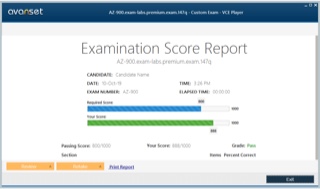
practice exams:
Pass Logical Operations Certification Exams at the First Attempt Easily
Real Logical Operations Exam Questions, Accurate & Verified Answers As Experienced in the Actual Test!
Logical Operations Certification Exam Dumps, Logical Operations Practice Test Questions
Don't miss out on the opportunity to get certified with the help of this ever-popular ExamLabs platform that provides you with only verified and legit Logical Operations certification practice test questions and answers in VCE format, training courses, and study guides. So, if you're looking to pass your Logical Operations certification exams then with ExamLabs practice test questions and exam dumps you can surely pass your exam quickly and easily.
Logical Operations and CertNexus: Cybersecurity, AI, Data, and IoT
Logical Operations is both a training/content organization and closely connected to CertNexus, the certification body for vendor-neutral emerging-technology credentials. Current CertNexus materials identify training developed or delivered through Logical Operations, and accreditation references use the legal identity Logical Operations Incorporated (doing business as CertNexus). Candidates should therefore distinguish the certification body (CertNexus) from Logical Operations training while understanding that the organizations are closely related.
Current CertNexus material includes CFR-410 CyberSec First Responder, while older Logical Operations-branded credentials such as Cyber Secure Coder and IoT Security Practitioner ITS-110 require version awareness. Older codes should be treated as historical unless current CertNexus material still lists them.
CertNexus is the current certification identity
CertNexus focuses on vendor-neutral emerging technologies including cybersecurity, artificial intelligence, data science, data ethics, Internet of Things, and related business/technical roles. Logical Operations remains active as a training organization and authorized-program provider.
The CertNexus certifications is therefore the right current exam for new credential planning. Logical Operations-branded exam history can still explain earlier versions and training lineage.
Choose the current credential from the role you need: incident response, AI implementation, data science, IoT, secure coding, or another emerging-technology discipline.
CFR-410 is the current CyberSec First Responder exam
The CyberSec First Responder CFR-410 exam is an active CertNexus cybersecurity certification. CertNexus describes it as a practitioner-level vendor-neutral credential for threat detection, incident response, and defense before, during, and after a cybersecurity incident.
Current first-party details list 80 multiple-choice/multiple-response items and a 120-minute appointment, including administrative/tutorial time. It is offered in person at Pearson VUE centers or online through Pearson OnVUE.
CFR is also ANAB-accredited under ISO/IEC 17024 and approved under current U.S. DoD 8140 workforce requirements.
CFR preparation should include common detection data and response tooling rather than product-specific memorization. Endpoint processes, authentication logs, DNS, proxy/firewall records, packet data, email headers, cloud audit events, file hashes, and threat intelligence each provide partial evidence.
Prioritization should consider confidence and consequence. A suspicious event on a privileged identity controlling production systems deserves different treatment from the same weak signal on an isolated test machine.
Incident response starts before an incident occurs. Responders need asset visibility, logging, alerting, roles, escalation paths, communication, evidence procedures, containment authority, backups, threat intelligence, and tools before attackers arrive.
Preparation should connect network, endpoint, identity, cloud, application, DNS, email, and security-device evidence. One alert is rarely the full attack chain.
When responding, preserve evidence and reduce harm. Isolate compromised hosts or accounts where appropriate, but document actions and avoid destroying artifacts needed to understand scope and root cause.
Detection requires hypotheses and context. Security operations should distinguish an indicator from an incident. A malicious IP match can be false or irrelevant; unusual process behavior without a known indicator can be highly suspicious.
Analysts should build timelines: initial access, execution, persistence, privilege escalation, credential use, discovery, lateral movement, command/control, collection, exfiltration, and impact where evidence supports those stages.
Business context matters. A domain controller, payment server, developer laptop, and kiosk have different criticality and expected behavior.
AI practitioner certifications validate applied AI work
CertNexus currently offers Certified Artificial Intelligence Practitioner and business-oriented AI programs, while Logical Operations Training actively delivers AI certification courses. These programs focus on implementing AI/ML solutions, data, model development, operationalization, ethical practice, and business value according to the credential.
AI candidates should understand data preparation, training/validation, model metrics, overfitting, deployment, monitoring, privacy, bias, security, and lifecycle.
Generative and agentic AI add prompts, retrieval, tools, model/provider dependency, evaluation, prompt injection, and automated-action controls. The organization should measure whether AI solves the intended business problem, not merely whether a demonstration looks impressive.
Model evaluation should include failure cases and business thresholds. Precision/recall, error cost, fairness, robustness, explainability, latency, and operational cost may all influence whether a model is acceptable. A high aggregate accuracy can still hide severe errors in a minority or high-impact class.
For generative systems, maintain representative evaluation prompts and expected evidence so changes in model, retrieval, or prompt configuration can be compared rather than judged informally from a few conversations.
Data science certifications connect analysis with production use
CertNexus data-science programs validate the ability to acquire, prepare, analyze, model, communicate, and operationalize data. Current training calendars continue to show Certified Data Science Practitioner courses delivered through authorized providers including Logical Operations Training.
Data science should begin with a business question and reliable data. Clean rows and high model accuracy are not enough if the target variable leaks future information or the result cannot influence a real decision.
Production models need monitoring, ownership, versioning, retraining or retirement criteria, and communication of limitations.
Data ethics should be considered before modeling begins. Collection purpose, consent or authority, sensitive attributes, representativeness, labeling quality, retention, and downstream use can create risk even when the mathematics is technically correct.
Communicating uncertainty is part of professional competence. Business stakeholders should know which assumptions, confidence limits, data gaps, or failure cases could change the recommendation rather than receiving one apparently precise model score without context.
IoT security connects cyber risk with physical devices
The ITS-110 IoT Security Practitioner represents an older Logical Operations/CertNexus exam generation. The concepts remain useful: device identity, secure boot, firmware, network segmentation, protocols, cloud services, lifecycle, privacy, physical access, and incident response.
IoT devices can remain deployed for years and may have weak update mechanisms. Security architecture should consider the entire lifecycle from procurement and onboarding through maintenance and secure retirement.
Current candidates should verify the live CertNexus IoT-security credential before using ITS-110 as an exam target.
Cyber Secure Coder is another legacy Logical Operations lineage
The Cyber Secure Coder exam reflects an earlier Logical Operations-branded secure-development credential in the CertNexus lineage. Secure coding concepts remain durable even if the exam code or program branding changes.
Developers should understand input validation, output encoding, authentication, authorization, session handling, secrets, cryptography, dependency risk, logging, error handling, and secure design.
Software security is most effective when requirements, coding, review, testing, CI/CD, deployment, and monitoring all contribute rather than waiting for a penetration test at the end.
Authorized training and certification are separate decisions
Logical Operations provides training and curriculum for CertNexus and other authorized programs. CertNexus does not require specific training for most certification exams unless the program explicitly says otherwise.
Candidates can choose official/authorized training, self-study, labs, or other resources while the certification exam remains governed by CertNexus exam policies.
On professional profiles, use the CertNexus credential title and identify Logical Operations as training provider only when that distinction is relevant.
Organizations purchasing training at scale should also distinguish course completion from certification attainment. A course can prepare employees and provide practical labs; the independent proctored exam is the evidence used for the professional credential where the certification program requires it.
Version control matters across old exam codes
The CertNexus candidate handbook and legacy materials preserve older codes such as CSC-110, ITP-110, ITS-110, and older CFR versions. Current CertNexus pages may use newer codes such as CFR-410 and updated curricula.
Verify exam code, launch/sunset information, delivery method, and current credential page.
Legacy credentials remain valid historical achievements when labeled accurately; new candidates should select the current certification.
Organizations that maintain internal skills matrices should update those records when CertNexus replaces an exam version. Preserve the employee's earned credential history, but map the current role requirement to the live exam or renewal policy rather than forcing experienced staff to appear “uncertified” simply because an old code disappeared from the storefront.
Prepare by solving one emerging-technology problem end to end
- Use CertNexus as the current certification authority.
- For CFR, investigate a full incident from detection through recovery.
- For AI/data, build a model or AI workflow and measure business value plus risk.
- For IoT, map device identity, network, firmware, cloud, data, and lifecycle security.
- For secure coding, integrate security into development and CI/CD.
- Use Logical Operations training where it fits your learning path.
- Label CSC/ITS and other older codes as versioned legacy unless current status is confirmed.
Logical Operations' modern certification story is best understood through CertNexus. The current value is vendor-neutral validation of emerging-technology skills, supported by practical training and updated certification programs as cybersecurity, AI, data, and IoT evolve.
Build evidence for the credential you choose. A CFR candidate can maintain an incident timeline and response report; an AI practitioner can document model evaluation and deployment; a data-science candidate can show data preparation, validation, interpretation, and monitoring; an IoT-security candidate can produce an asset/threat/control map. Practical artifacts make the certification story more credible than the badge alone.
Before booking, verify the current CertNexus exam code and sunset status. Historical Logical Operations materials remain searchable and can use codes that have since been replaced even though the underlying training concepts are still recognizable.
Choose labs that produce inspectable evidence—logs, code, model metrics, packet captures, or reports—so mistakes can be diagnosed instead of merely retried.
Keep the current exam blueprint beside the lab so every practical artifact maps to a competency the certification actually assesses.
Updated & latest Logical Operations certification exam dumps from ExamLabs, Study Guide and Training Courses which are prepared by seasoned experts in order to help you pass. With Real Logical Operations certification practice test questions and answers and verified exam dumps you will pass the Actual Real World Exam in No Time. Logical Operations exam dumps & practice test questions with answers from ExamLabs make sure that you pass your Logical Operations certifications easily and climb you career ladder easily.
How to Open VCE Files
Please keep in mind before downloading file you need to install Avanset Exam Simulator Software to open VCE files. Click here to download software.