practice exams:
Pass Test Prep Certification Exams at the First Attempt Easily
Real Test Prep Exam Questions, Accurate & Verified Answers As Experienced in the Actual Test!

































Exam |
Title |
Files |
|---|---|---|
|
2
|
||
|
2
|
||
|
4
|
||
|
2
|
||
|
2
|
||
|
2
|
||
|
2
|
||
|
2
|
||
|
2
|
||
|
4
|
||
|
2
|
||
|
2
|
||
|
2
|
||
|
2
|
||
|
2
|
||
|
4
|
||
|
2
|
||
|
2
|
||
|
2
|
||
|
2
|
||
|
2
|
||
|
2
|
||
|
4
|
||
|
2
|
||
|
2
|
||
|
2
|
||
|
2
|
||
|
1
|
||
|
2
|
||
|
2
|
||
|
2
|
||
|
2
|
||
|
2
|
||
|
2
|
||
|
2
|
||
|
2
|
||
|
4
|
||
|
2
|
||
|
2
|
||
|
2
|
||
|
1
|
||
|
2
|
||
|
2
|
||
|
2
|
||
|
2
|
||
|
2
|
||
|
2
|
||
|
2
|
||
|
2
|
||
|
2
|
||
|
2
|
||
|
1
|
||
|
2
|
||
|
2
|
||
|
6
|
||
|
2
|
Hot Test Prep Tutorials
See All














Test Prep Certification Exam Dumps, Test Prep Practice Test Questions
Don't miss out on the opportunity to get certified with the help of this ever-popular ExamLabs platform that provides you with only verified and legit Test Prep certification practice test questions and answers in VCE format, training courses, and study guides. So, if you're looking to pass your Test Prep certification exams then with ExamLabs practice test questions and exam dumps you can surely pass your exam quickly and easily.
Test Prep Works Best When Every Study Session Produces Evidence
Good test preparation is not a pile of notes, videos, flashcards, and practice questions. It is a feedback system. You begin with the official exam scope, test what you can actually recall or perform, identify a weakness, practice that weakness deliberately, and test again under conditions that make the result meaningful. The specific resources change from exam to exam, but the logic of preparation remains remarkably stable.
This matters because studying can feel productive without changing performance. Rereading a familiar chapter creates recognition. Watching an expert solve a problem creates the impression that the steps are obvious. Highlighting an answer explanation creates a clean page. None of those activities proves that you can produce the answer independently when the prompt is unfamiliar and time is limited. A useful study plan therefore measures retrieval, reasoning, and execution rather than time spent near the material.
Freeze the current exam scope before you build a schedule
Start with the official objectives, blueprint, content outline, or candidate handbook for the exact exam version you will take. Record the exam code, revision, retirement or transition date if any, delivery method, question formats, and major domain weights. If the vendor publishes a change notice, read it before using a third-party study guide. Version confusion can waste weeks because older resources often remain searchable after an exam has changed.
Convert the outline into a coverage map. Each objective should have a status such as unknown, explainable, performable, or verified under practice. “Explainable” means you can describe the concept without notes. “Performable” means you can complete the task or solve the scenario. “Verified” means you have succeeded more than once, including after a delay. This is more informative than a progress bar based on chapters completed.
Use a diagnostic before deep study
A diagnostic exam or question set is valuable because it reveals where your current model is weak. Take it early enough that a poor score is useful rather than discouraging. Do not over-interpret the percentage from a single set; instead, inspect the error categories. Were the misses concentrated in one domain? Did you know the concept but misread the scenario? Did timing force guesses? Did two plausible options expose a distinction you had never learned?
After the diagnostic, make a short prioritized backlog. Fix high-weight domains and foundational concepts first because they often unlock several later topics. A practice set such as an Amazon EC2 is most useful when it leads to targeted study rather than another immediate full test. Practice questions should tell you what to do next.
Retrieval should replace most passive review
Once a topic has been introduced, close the source and retrieve it. Write the architecture from memory, explain the policy in your own words, solve the calculation without the worked example, or list the troubleshooting sequence before checking the notes. The effort is a feature: retrieval exposes missing connections that rereading hides.
Use short prompts rather than giant flashcards. “What are the conditions for this control?” is better than copying an entire textbook paragraph. For technical exams, retrieval can be executable: build the command, configure the policy, query the database, read the packet capture, or identify the failing component. For professional exams, explain why one decision fits and why the nearest alternative does not. The goal is to reproduce the reasoning the exam will demand.
Spaced review should be driven by forgetting
Study sessions should revisit material after enough time has passed for recall to become effortful. A simple schedule—same day, a few days later, one week later, and again before the exam—works better than repeatedly reviewing one topic in a single sitting. Difficult topics need shorter intervals; stable topics can be checked less often.
Maintain a “fragile knowledge” list. A concept enters the list when you miss it, guess correctly, or cannot explain why the correct answer is right. It leaves only after repeated successful retrieval. This prevents the common mistake of studying the topics you enjoy while avoiding the uncomfortable ones. Your schedule should be shaped by evidence of forgetting, not by which chapter is easiest to reread.
Practice tests need realistic conditions and careful review
Full-length practice tests are useful late in preparation when you need evidence about endurance, timing, question switching, and score stability. They are much less useful if taken repeatedly without repair between attempts. The role of practice tests is diagnostic as much as predictive: every wrong answer and every uncertain correct answer is a clue about the study system.
Simulate the constraints that matter. Use the same approximate time limit, avoid notes if the real exam is closed book, and do not pause whenever a difficult question appears. Afterward, review slowly. For each miss, write the concept, the reasoning error, and the corrective action. Then create a small follow-up drill from the same idea using different wording. The review can take longer than the test; that is often where most learning happens.
Technical exams require labs that force decisions
A guided lab is useful the first time you learn a tool, but repeating the same clicks can become passive. Convert instructions into a requirement. Instead of “configure a virtual network using these steps,” write “two application tiers need controlled communication, private address space, outbound access, and no direct public exposure.” Then build a design without looking at the original walkthrough.
Add failure. Delete a route, break a permission, rotate a credential, change a schema, or create an alert condition. Diagnose the problem using evidence. Exams often test the relationship between configuration and outcome, and failure-oriented labs make that relationship visible. A Spring Professional certification should therefore be converted into scenarios rather than followed as a recipe.
Nontechnical exams still benefit from scenario practice
Project management, finance, healthcare, legal, and licensing exams often test judgment within a defined body of rules. Practice by identifying the actor, objective, constraint, and governing rule before looking at answer options. If two answers are plausible, explain what fact in the question makes one more appropriate. This turns “test-taking tricks” into disciplined interpretation.
For quantitative sections, separate conceptual errors from arithmetic errors. For reading-heavy sections, note whether the miss came from vocabulary, inference, scope, or rushing. For policy-heavy exams, keep jurisdiction or standard-specific rules distinct from general professional principles. The method is the same as technical preparation: diagnose the reason for the error and choose a corrective activity that targets it.
A realistic schedule protects the final week
Do not build a plan that assumes perfect daily study. Estimate available hours conservatively and include buffer. A useful sequence is foundation, domain practice, mixed practice, timed simulation, and final repair. The final week should not contain a large untouched domain unless circumstances changed unexpectedly. It should be used to stabilize knowledge, rehearse logistics, and close a small number of high-value gaps.
Schedules such as an realistic MCAT study schedule illustrate the broader principle: preparation has to fit the learner’s actual calendar. Track completed study by outcomes—objectives verified, labs completed, error categories reduced—not by aspirational hours. A plan that survives ordinary interruptions is better than an aggressive plan that collapses after one missed day.
Stop studying when the evidence is stable
Readiness is not a feeling of having seen everything. It is a pattern of performance. You can explain the major objectives without notes, complete representative tasks, distinguish near-neighbor concepts, and achieve stable results across fresh mixed practice. Your errors are few enough to analyze individually rather than appearing everywhere. You also understand the exam logistics well enough that check-in, timing, and question format are not surprises.
At that point, more volume can create fatigue without adding much knowledge. Use the final sessions for short retrieval, a small number of weak topics, and confidence in the process you have practiced. The best test-prep system is not the one with the most resources. It is the one that repeatedly converts uncertainty into evidence, evidence into targeted work, and targeted work into reliable performance.
Keep the study system small enough to maintain. One objective map, one error log, one set of current notes, and a limited pool of fresh practice material are usually more useful than ten overlapping courses. When two resources disagree, return to the official source and record the resolution. Resource management is part of preparation because contradictory or outdated materials can create uncertainty that no amount of extra practice fixes.
Sleep, breaks, and exam-day routine also affect the quality of the evidence you collect. A late-night score after several hours of study may measure fatigue more than knowledge. Use at least some timed practice at the same time of day as the real exam, and rehearse the check-in or technical requirements if the test is remote. The aim is to make the exam day ordinary enough that your result reflects what you know rather than avoidable logistical stress.
Use that same evidence after the exam to improve the next plan. Record which preparation methods transferred well under real timing, which weak areas remained, and which materials added little value. A short post-exam review turns one testing experience into better planning for the next credential instead of forcing the preparation process to start from zero.
Updated & latest Test Prep certification exam dumps from ExamLabs, Study Guide and Training Courses which are prepared by seasoned experts in order to help you pass. With Real Test Prep certification practice test questions and answers and verified exam dumps you will pass the Actual Real World Exam in No Time. Test Prep exam dumps & practice test questions with answers from ExamLabs make sure that you pass your Test Prep certifications easily and climb you career ladder easily.
How to Open VCE Files
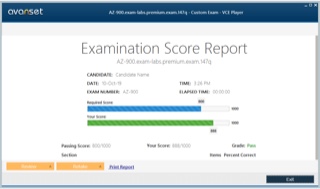
Please keep in mind before downloading file you need to install Avanset Exam Simulator Software to open VCE files. Click here to download software.